
Sizing KNX Power Supplies
How to choose the right KNX power supply: add up device current, pick 320 or 640 mA, leave headroom, and place it correctly on the line.
The KNX power supply is the most underestimated component on the bus. It delivers the 30 V DC that powers every device and carries data on the same pair. Undersize it and the bus becomes unstable under load; ignore placement and distant devices drop out. Sizing it is simple arithmetic, this guide walks through it.
What a KNX power supply does
More than a power brick.
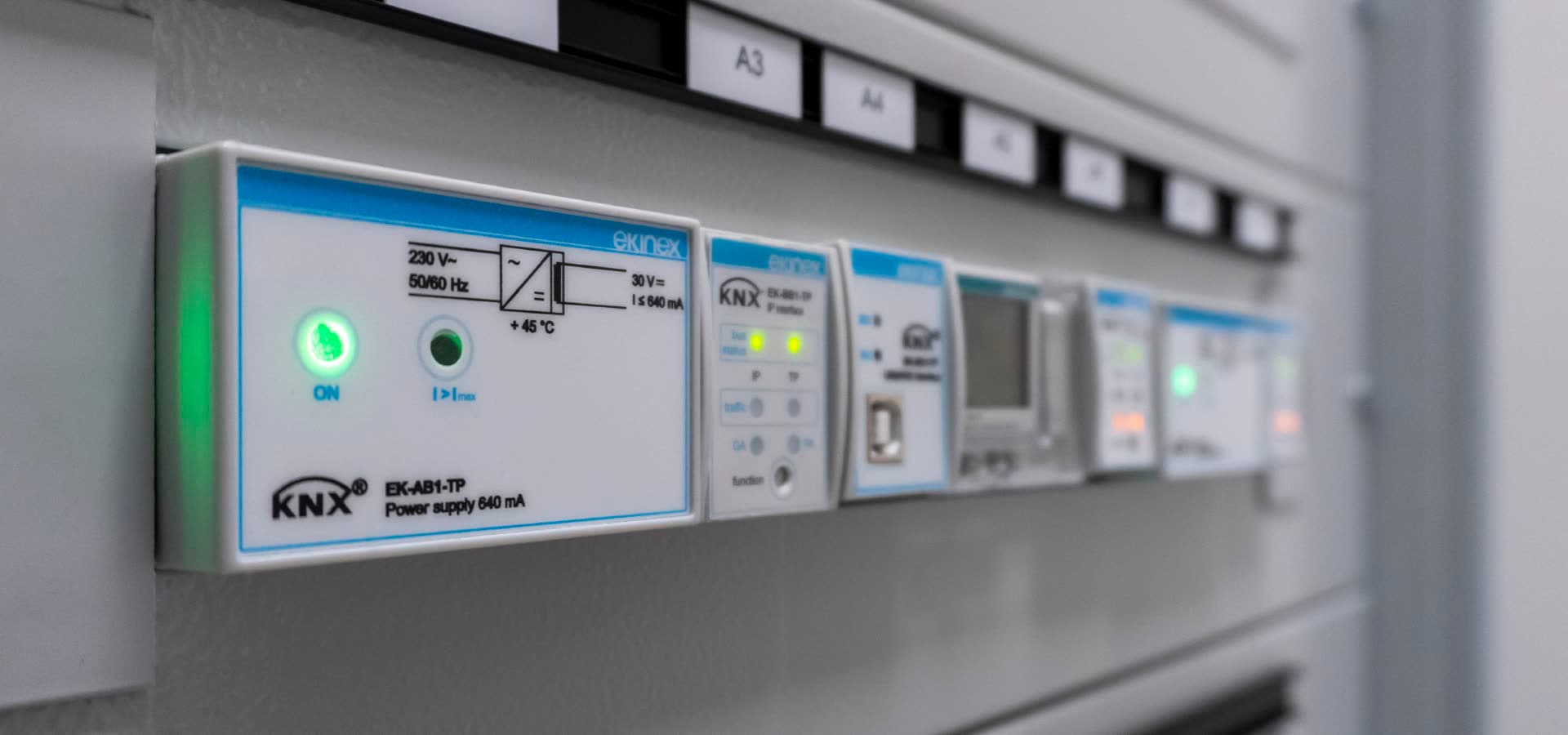
A KNX power supply outputs a stabilised 30 V DC and integrates a choke (inductor) that decouples data from power, letting both share one twisted pair. This is why you cannot substitute an ordinary 30 V DC supply, without the choke, telegrams are shorted out.
Each line segment needs exactly one KNX power supply. Two supplies on one segment, or feeding two segments across a coupler from one supply, will cause faults.
- Outputs stabilised 30 V DC (devices work down to ~21 V)
- Built-in choke decouples data from power
- One power supply per line segment
- Never substitute a plain 30 V DC supply
| Bus voltage | 30 V DC nominal |
| Min at device | ≈ 21 V |
| Per line segment | 1 supply |
| Common ratings | 320 / 640 / 1280 mA |

How to size the supply
Add up device current, then add headroom.
Every KNX device has a bus-current draw in its datasheet, typically 5–15 mA. Sum the draw of all devices on the line segment; that total must be comfortably below the supply rating. A 640 mA supply, for instance, comfortably feeds dozens of typical devices.
Leave headroom, aim to use no more than ~80% of the rated current so the system tolerates future additions and inrush. If a segment exceeds a supply's capacity, split it with a line/segment coupler and add a second supply.
- Sum each device's bus current (datasheet, ~5–15 mA each)
- Pick a rating with ≥ 20% headroom (320 / 640 / 1280 mA)
- Heavy segments: split with a coupler + second supply
- Account for inrush and future devices
| Typical device draw | 5–15 mA |
| Target utilisation | ≤ 80% of rating |
| If over capacity | split segment + add supply |
When in doubt, go one size up. The cost difference between 320 mA and 640 mA is small compared with the cost of diagnosing an overloaded bus on a finished project.
Placement and distance rules
Where the supply sits matters as much as its size.
Distance limits are measured from the power supply: no device should be more than 350 m of cable from its supply, no two devices more than 700 m apart, and total cable per line ≤ 1000 m. Placing the supply centrally in the line shortens the worst-case path.
On large segments a second power supply can extend reach, but follow the manufacturer's rules on minimum spacing between supplies.
- ≤ 350 m from supply to any device
- ≤ 700 m between any two devices
- ≤ 1000 m total cable per line
- Place the supply centrally to shorten worst-case runs
These distances are the same as in our KNX topology and cable installation guides, power, topology and cabling are one design problem, not three.
Reliability and good practice
A few habits prevent most bus faults.
Mount the supply on the DIN rail in the distribution board with the rest of the KNX components, label it, and keep a note of the line it feeds. For critical installations, some integrators provide separate supplies per functional area so a fault is contained.
Check the supply's diagnostic LEDs during commissioning and record the measured bus voltage at the most distant device, it should stay comfortably above the device minimum under load.
- DIN-rail mount in the distribution board, clearly labelled
- Separate supplies per area for fault containment (critical sites)
- Verify bus voltage at the most distant device under load
- Keep spare current capacity documented
Virasmart engineers size power supplies, topology and cabling together as one design. Planning a KNX project in the Baltics? Talk to us before procurement.
Product catalogue
Browse matching products
All pricing is issued per project. Build a quotation list in the catalogue. Our engineers will reply with a technical quote by email.
Specifying a KNX system?
Virasmart engineers power, topology and cabling as one design for residential and commercial KNX projects across the Baltics.